
Carroll Projected and Actual Release
A projected release date is a snapshot built from the sentence, time already credited, the governing credit system, and later computation events. An actual release date records what occurred. The two may match, but they answer different questions. A future date can change before it arrives. For a person already out, the projected field should not be used as proof of release. Seek the actual NRVRJ departure record, VADOC release or discharge record, or dated court and custody documents.
Pretrial cases work differently. A person held at New River Valley Regional Jail while a Carroll County case is pending does not have a sentence-based release date. Release may follow personal recognizance, unsecured bond, secured bond, dismissal, or another court order. A detainer, which is a request by another authority to keep or receive the person, may prevent community release even when the Carroll case changes. Ask the jail whether the booking ended and whether the person left for the community or another custodian.
| Person’s status | Useful date source | What confirms release |
|---|---|---|
| Carroll pretrial detainee | Bond and court events, not a computed sentence date | NRVRJ release or transfer entry |
| Local sentenced person | Carroll sentencing order, jail credit, and NRVRJ records | Actual NRVRJ departure record |
| VADOC state prisoner | VADOC projected date fields and computation record | VADOC actual release or discharge documentation |
| Person on supervision | VADOC status and supervision end information | Correctional-status or discharge record |
Find Carroll Projected Release Dates
Start with jurisdiction and custody. Carroll adults committed to local jail custody generally go to NRVRJ in Dublin. A state-responsible person can later transfer to VADOC. The VADOC Inmate and Supervisee Locator covers people in state custody or under state supervision, not every short regional-jail stay. It allows a DOC ID search or a name search using the requested first-name portion and full last name. Compare the VADOC number, status, facility or district, and the exact date label displayed.
The assigned VADOC locator image shows the official search fields and disclaimer used for a Carroll County projected release lookup. Open the live VADOC locator to check current labels.
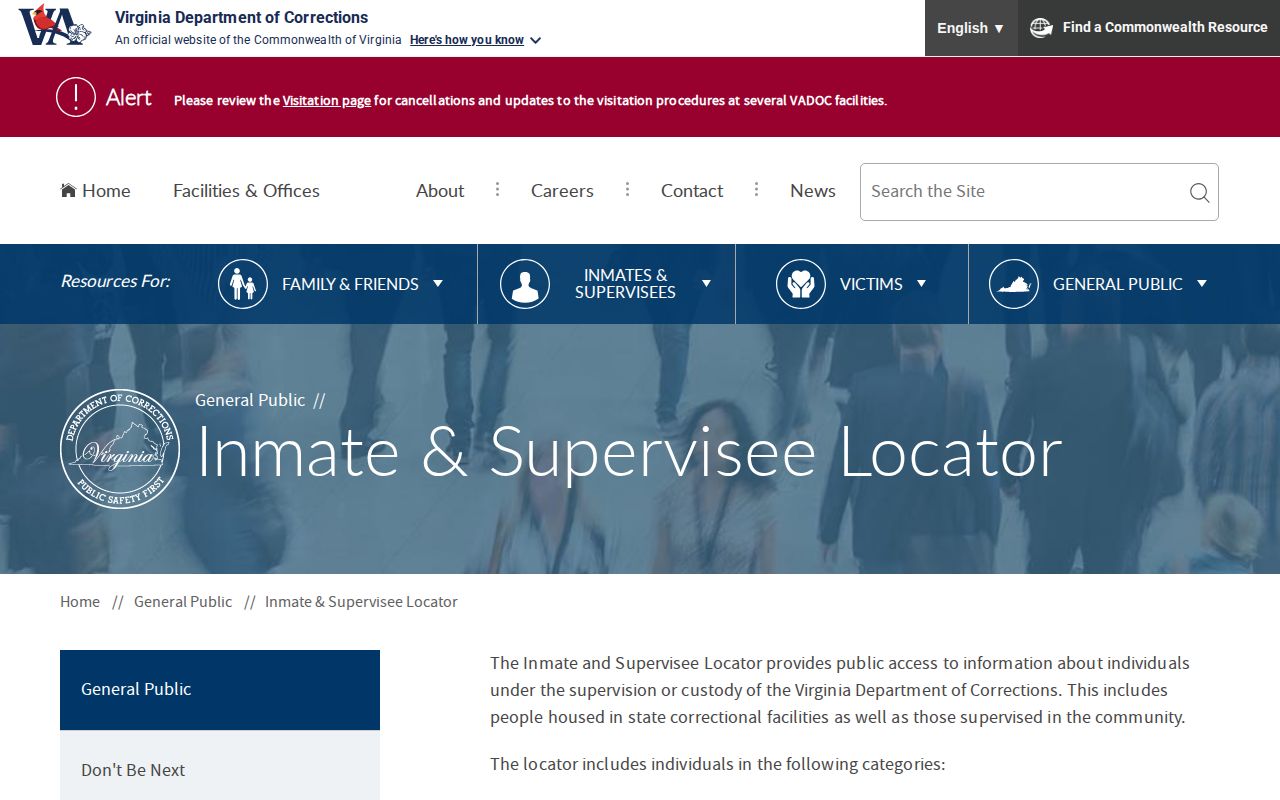
The locator is updated daily according to VADOC, but its disclaimer warns that information may be inaccurate or out of date. Record the access date.
- Identify the Carroll case, booking episode, full legal name, date of birth, and DOC or booking number when known.
- Determine whether NRVRJ or VADOC currently holds the person. A transfer from NRVRJ is not community release.
- For VADOC custody, search by DOC ID if possible and transcribe the projected date label exactly.
- For a local sentence, obtain the sentencing order and jail-credit information, then ask NRVRJ for the computed or actual release record.
- Check for later court orders, consecutive cases, detainers, or disciplinary changes before treating the date as current.
- After the date passes, request the actual release or discharge record rather than relying on the old projection.
The full county booking and court verification chain appears on the Carroll County released-inmate search. It is useful when the question changes from a future estimate to whether release already occurred.
Carroll Release Date Labels
VADOC material uses several date concepts. An anticipated release is an advance estimate, and its victim-notification material says such notice is normally sent about 30 days ahead. A later notice may follow if the estimate changes. “Release date” means the point when VADOC custody ends. VADOC records policy also identifies projected parole-eligibility, projected mandatory-parole, and projected good-time-release dates as public information. None should be silently renamed as a guaranteed date.
A parole eligibility date is only the first point at which a legally eligible case may receive review. It is not a grant and does not establish physical release. The Virginia Parole Board decides discretionary parole in the limited cases where that system still applies. Virginia abolished discretionary parole for most felonies committed on or after January 1, 1995, subject to narrow exceptions. The offense date and statute therefore matter before a parole date is read as meaningful.
- Projected good-time release
- A calculated date that applies sentence credit under the controlling rules.
- Parole eligibility
- A possible review point for a legally eligible case, not a release order.
- Actual release
- The dated event when the named custodian ended its physical custody.
- Final discharge
- The end of both custody and the applicable supervision obligation.
Note: Save the exact Carroll County release-date label, the source, and the date accessed so later changes can be explained accurately.
Virginia Credits Shape Carroll Release
Virginia uses two broad sentence-credit systems. Good Conduct Allowance generally applies to felonies committed before January 1, 1995 and older misdemeanors. Earned Sentence Credit applies to post-1995 felonies. Under Virginia Code § 53.1-202.3, listed ESC-1 offenses can earn from zero through 4.5 credits for each 30 days served. Eligible ESC-2 offenses can earn up to 15 credits per 30 days depending on classification and compliance. One credit deducts one sentence day.
Sentence computation begins with the final order. Staff account for the total imposed term, suspended time, whether terms run together or one after another, and pre-receipt jail credit under §§ 53.1-186 and 53.1-187. The applicable earning level, mandatory minimum, program rules, and later orders can alter the result. A short Carroll jail sentence should not be calculated by copying a state-prison formula.
The official VADOC Time Computation explanation describes why a date can move as records arrive and credits change.
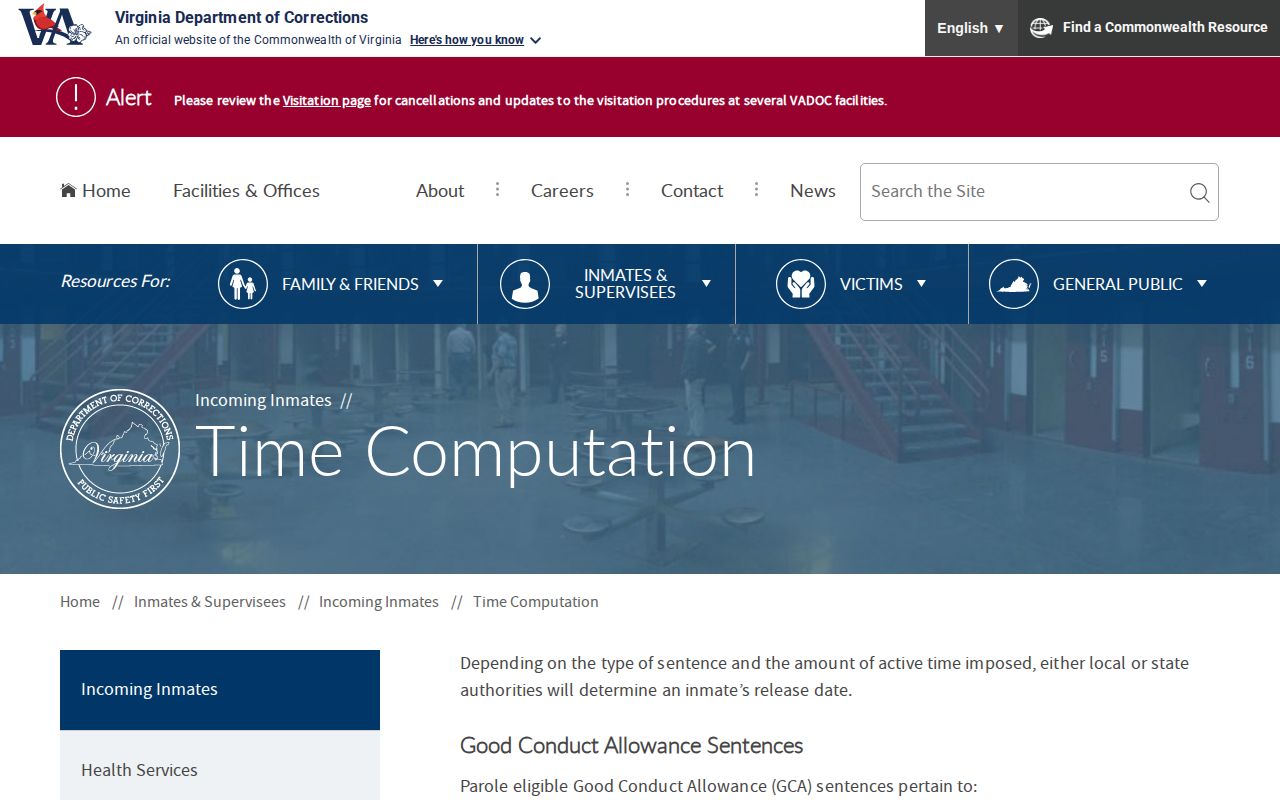
The screenshot supports the computation process, not a promise about any one Carroll County prisoner’s final release day.
Why Carroll’s 85% Estimate Fails
The familiar “85 percent” shorthand is not a universal Virginia calculation. At the 4.5-credit rate, 30 days actually served satisfy 34.5 sentence days. That is about 86.96 percent actual service for that segment, not exactly 85 percent. Other offenses and ESC earning levels can produce different results. Good Conduct Allowance follows another framework, and mandatory minimum time may not be reduced in the same way.
Carroll County local-jail credit adds another branch. Virginia Code § 53.1-116 provides a local-jail framework, including one-for-one good conduct for qualifying misdemeanor sentences of 12 months or less. Extra program or work credit depends on what the jail makes available. The research did not establish a special NRVRJ program-credit promise for every person, so no such reduction should be assumed.
Offense date, offense category, earning level, jail credit, discipline, consecutive orders, and the statutory version all belong in the analysis. The safest answer is the agency’s current computation label, not arithmetic based on a headline percentage.
Changes to Carroll Release Dates
A projected date can move in either direction when the legal or factual inputs change. VADOC identifies pre-receipt jail time, sentence type, total imposed term, earning level, discipline, and other computation events as variables. An escape or attempt can forfeit accrued credits under § 53.1-189, and only the Director can restore forfeited credit. A corrected order or newly posted jail credit may also change the date.
| Factor | Possible effect | Record to check |
|---|---|---|
| Jail credit | Reduces remaining time when lawfully awarded and posted | Sentencing order and computation record |
| Earned-credit level | Changes the rate at which sentence days are satisfied | VADOC time-computation record |
| Discipline or escape | Can reduce or forfeit accrued credit | VADOC credit and disciplinary record |
| New or corrected court order | Can change the term or consecutive structure | Carroll court judgment |
| Detainer or another hold | Can send the person to another authority instead of the community | Release destination and receiving-agency record |
| Parole action | May create, delay, or rescind a conditional-release path in an eligible case | Parole Board decision and VADOC release record |
A change in custodian is just as important as a change in date. If NRVRJ transfers a Carroll County person to VADOC, the regional-jail booking ended while confinement continued. If VADOC completes a sentence but delivers the person on a detainer, VADOC custody ended while another authority’s custody began. The destination field prevents both events from being mislabeled as community release.
Carroll Local Sentence Release Records
A local Carroll sentence should be traced from the court order to NRVRJ’s custody record. General District Court handles many misdemeanor cases, while Circuit Court is the durable source for felony judgments, appeals, and longer sentences. Read the imposed term, suspended portion, and jail-credit language together. “Suspended” means that part is not served at once if the person follows the order. It is not the same as credit for days already confined.
NRVRJ is the booking and release custodian for committed Carroll adults, even though the jail is in Dublin outside Carroll County. Call 540-643-2000 with the full name, date of birth, Carroll case number, and booking number when known. Ask for the computed release information and, once the episode ends, the actual date, time, release type, and destination. The research found no published NRVRJ release-record fee schedule or public promise about computation cadence.
Carroll County Lockup is a short local holding point under Sheriff Kevin A. Kemp, not the county’s long-stay jail. A person may leave that lockup directly after magistrate or court action, or may be transferred to NRVRJ. Ask the sheriff whether custody ended or moved. If the person went to NRVRJ, the lockup departure is not the projected community-release date. This handoff is why the court order and both custody records must be matched to the same episode.
Note: A court sentence supplies the legal term, while the jail’s dated record establishes the actual Carroll County custody endpoint.
Confirm Carroll County Release
When the projected day approaches, check the same system again and preserve its current label. For NRVRJ, call 540-643-2000 and ask whether the person remains held, whether that booking ended, and whether the endpoint was community release or transfer. For a VADOC prisoner, use the locator and request actual release or discharge documentation from the responsible records office after the event. A dated Facility Custody Release Report entry may provide a formal fallback for a person released on supervision, parole, or discharge during the prior month.
Virginia VINE can send a custody-change alert for a participating record. An alert should prompt another check because release, transfer, escape, and return are distinct events. The Carroll County VINELink Inmate Search explains how to register for the offered event types and confirm the notice. VINE is not the legal custodian, and silence from the system does not prove continued custody.
If sources conflict, report the date as unresolved. Compare the Carroll court order, the NRVRJ booking episode, the VADOC status, and any receiving agency. A current official record is more reliable than an old estimate, and an actual departure record is the right evidence after the future date has passed.
Public Record Search
Sponsored Results